
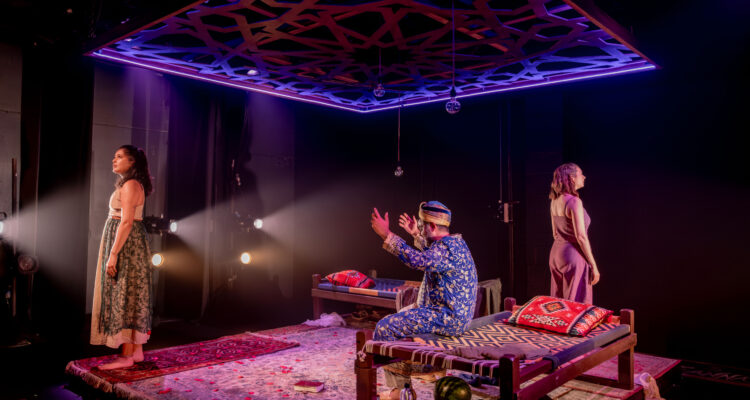
There are productions that invite you in gently, and then there are productions that ask you to surrender almost immediately to their world. The Caged Bird Sings, now playing at Tarragon Theatre’s Extraspace, belongs firmly in the second category.
Presented by Tarragon Theatre as a Modern Times and Theatre ARTaud production, the piece is a radical reimagining of Rumi’s Masnavi, created by Rouvan Silogix, Rafeh Mahmud, and Ahad Lakhani, and directed by Mahmud. Inspired by Sufi mysticism and concepts of spiritual dissolution, the production explores cages both literal and psychological: the prisons we are placed in, the ones we inherit, and the ones we build for ourselves.
The story centres on three prisoners: Rumi and Jin, star-crossed lovers and scientists, and Sal, a mysterious vagrant figure who shares their confined space. As they confront their past lives and uncertain present, the boundaries between memory, guilt, dream, and spiritual reckoning begin to blur.
At its strongest, The Caged Bird Sings is visually and atmospherically compelling. There is a clear sense of theatrical ambition in the way the production uses confinement, shadow, movement, sound, and heightened language to create a world that feels suspended between the earthly and the mystical. The Extraspace becomes less a room than a pressure chamber, where ideas about freedom, ego, love, death, and transcendence collide.
The performances help ground that abstraction. Mikaela Lily Davies, Navtej Sandhu, and Rouvan Silogix commit fully to the emotional and physical demands of the work, finding moments of tenderness, humour, and intensity inside a script that often operates at a heightened philosophical pitch. The humour is especially welcome. Small flashes of levity cut through the density of the piece, allowing the audience to breathe before being pulled back into heavier questions.
But this is also where the production may divide audiences. The Caged Bird Sings is rich with ideas, sometimes overwhelmingly so. As the piece moves toward its later sections, its many threads begin to feel harder to hold. The blend of mysticism, allegory, romance, imprisonment, ghosts, inner demons, and philosophical transformation creates moments of beauty, but also moments of confusion. Rather than deepening into clarity, the ending risks becoming too diffuse, leaving the audience reaching for emotional resolution while the play keeps expanding into abstraction.
That complexity is not necessarily a flaw. In fact, part of the work’s purpose seems to be resisting easy answers. Still, there is a difference between mystery and muddiness, and at times the production blurs that line. The central question of escape — from the cage, from the self, from suffering — remains powerful, but the path toward it can feel uneven.
Even so, The Caged Bird Sings is not easily dismissed. It is ambitious, sensory, and spiritually charged, the kind of theatre that lingers because it refuses to settle neatly. It may frustrate as much as it fascinates, but it is undeniably reaching for something larger than conventional storytelling.
For audiences open to philosophical theatre, Sufi-inspired imagery, and work that prioritizes atmosphere over narrative clarity, this production offers a challenging and memorable experience. For those looking for a clean emotional arc, it may feel more elusive.
The Caged Bird Sings runs at Tarragon Theatre’s Extraspace through June 28, 2026. Tickets range from $24–$72 and are available through Tarragon Theatre.
👉 Tickets: https://purchase.tarragontheatre.com

Leave a Reply