
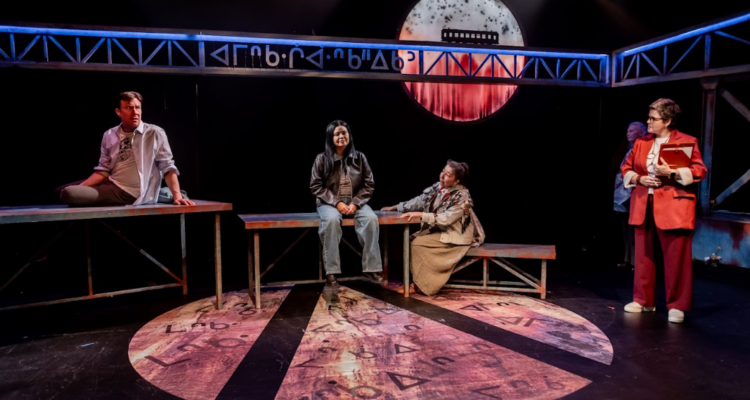
There’s a quiet tension that settles in early during Strife, now playing at Tarragon Theatre’s Extraspace — the kind that doesn’t rely on spectacle, but on what’s left unsaid.
Written by Matthew MacKenzie and directed by Yvette Nolan, this world premiere unfolds in the aftermath of a violent loss. Nathan, an Indigenous climate activist, is gone, murdered under circumstances that remain unresolved. What follows is not a mystery in the traditional sense, but something more unsettling: a story about the absence of answers, and the ripple effects that absence leaves behind.
At the centre is Monique, played with grounded intensity, a woman navigating grief that feels both deeply personal and politically charged. She is forced to reckon not only with the loss of her brother, but with the conflicting narratives that begin to form around his life and legacy. As someone working in the oil patch, her perspective collides with those of Nathan’s partner, his mentor, and others who claim to understand, or represent, who he was.
MacKenzie’s script leans into these tensions, asking difficult questions without rushing toward resolution. Who has the right to tell Nathan’s story? Does proximity as family, partner, or colleague grant authority? Or does lived experience matter more than ideology?
One of the play’s most compelling choices is its refusal to provide clear answers, including around Nathan’s death itself. We are left to assume, as the characters do, that his activism and identity may have made him a target. But that uncertainty becomes part of the drama. It fuels conflict, shapes perception, and exposes how quickly narratives can harden in the absence of truth.
What gives Strife its emotional texture, however, is not just its ideas, but its tonal shifts. There are moments of subtle humour, sometimes surprising, that cut through the heaviness of Monique’s grief. These interjections don’t undermine the seriousness of the story; instead, they make the characters feel more human. Laughter arrives not as relief, but as something closer to survival.
Visually and structurally, the play also moves between the real and the symbolic. Monique’s recurring dream, reconstructing her brother’s bones from an owl pellet introduces a haunting, almost mythic dimension. The presence of the Owl, both guide and witness, allows the production to step outside realism and into something more poetic, where grief becomes something that can be seen, shaped, and confronted.
The ensemble brings a strong sense of balance to the piece. Each character carries a distinct relationship to Nathan, and those relationships form the emotional architecture of the play. Rather than presenting a single perspective, Strife builds a chorus of voices each incomplete on its own, but collectively revealing the complexity of identity and memory.
There’s an underlying question that lingers long after the final scene: if Nathan’s death had been solved, would anything truly change? Would closure bring resolution, or simply allow everyone to return to the stories they’ve already chosen to believe?
Strife doesn’t offer easy answers and that’s precisely its strength. It’s a work that invites reflection rather than resolution, asking audiences to sit with discomfort and consider how we define identity, grief, and truth in a world that rarely offers certainty.
Strife runs at Tarragon Theatre’s Extraspace through April 26, 2026. Tickets range from $24–$72 and are available 👉 https://purchase.tarragontheatre.com

Leave a Reply