
Before the audience gasps, applauds, or leans forward in disbelief, there is rehearsal.
Inside Cirque du Soleil’s Big Top on Toronto’s waterfront, the magic of LUZIA begins long before showtime. Artists stretch, reset, check timing, test grip, rehearse landings, and move through sequences that will later appear effortless under theatrical light. But behind the dreamlike world audiences see on stage is a tightly coordinated machine of performers, technicians, designers, musicians, wardrobe teams, and crew members making the impossible feel fluid.
Now celebrating its 10th anniversary, LUZIA has returned to Toronto with one of Cirque du Soleil’s most visually distinctive touring productions. Inspired by an imaginary Mexico, the show blends acrobatics, live music, surreal imagery, animal-like puppetry, vibrant costumes, and one especially ambitious technical element: water.
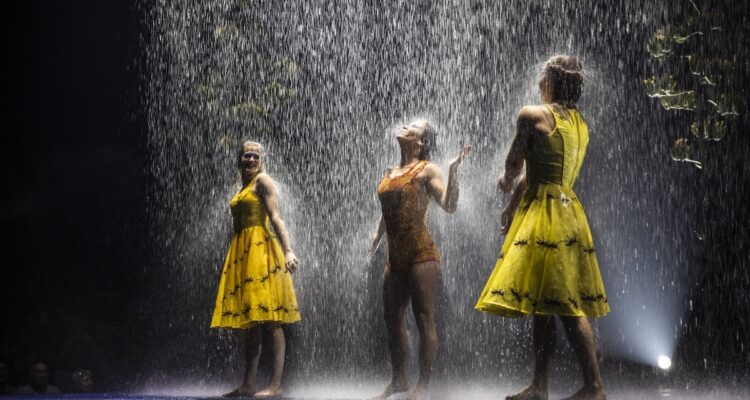
LUZIA is Cirque du Soleil’s first and only touring production to incorporate a large-scale rain system under the Big Top, using more than 10,000 litres of recycled water to create falling rain on stage. In rehearsal, that detail becomes even more impressive. Water may look magical from the audience, but backstage and on the floor, it adds another layer of precision. Artists are not only performing complex physical feats, they are doing so while navigating moisture, timing, surface changes, and the constant need for control.
That is what makes the rain curtain sequence so memorable. When performers spin on Cyr wheels or move through trapeze work as rain falls around them, the image feels poetic. Behind the scenes, it is also deeply technical: every cue, landing, entrance, and exit has to align with the music, lighting, and water effects. The result is one of the show’s signature moments, but its beauty depends on discipline.
The same is true of the hoop diving sequence, where artists run on a giant treadmill and launch themselves through hoops at speed. From the seats, the act feels thrilling and almost playful. In rehearsal, the level of coordination becomes clearer. Each jump depends on exact spacing, shared rhythm, and total trust among the performers. One mistimed step changes everything.
Costumes add another layer to the world of LUZIA. They do more than decorate the performers; they help define the show’s atmosphere, moving between festive colour, desert heat, dream imagery, and surreal character work. For artists, costumes also have to function physically. They must support movement, survive repetition, work under lighting, and hold up through acts that include water, aerial work, acrobatics, and high-speed choreography.
That balance between beauty and utility is part of what makes Cirque’s behind-the-scenes process so fascinating. Everything has to look effortless, but nothing can be accidental.
For Toronto audiences, seeing LUZIA after understanding even a little of its backstage world makes the performance richer. The Big Top spectacle is still there, but suddenly the details come into sharper focus: the timing of a catch, the sound of feet meeting the stage, the costume that moves perfectly with a body in flight, the way a performer resets after a difficult sequence, the crew quietly making the dream hold together.
It is easy to call Cirque magical. It is more interesting to see how much craft, labour, and precision are required to make that magic feel alive.
Cirque du Soleil’s LUZIA runs in Toronto under the Big Top at 2150 Lake Shore Blvd. W. through August 30, 2026. Performances run approximately 125 minutes, including intermission.
👉 Tickets: https://www.cirquedusoleil.com/canada/toronto/luzia/buy-tickets

Leave a Reply