
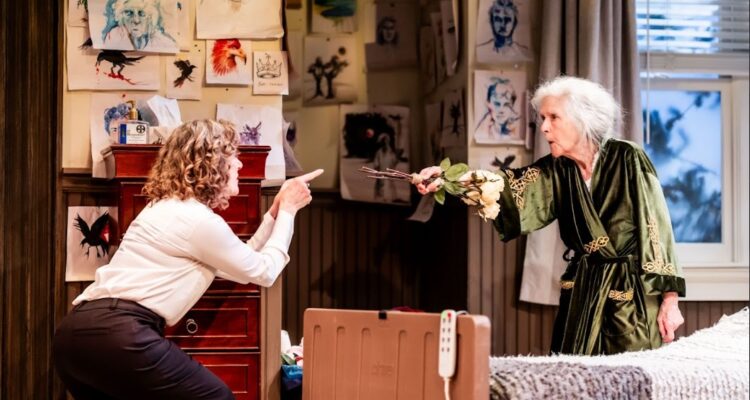
Some performances feel less like acting and more like a force of nature unfolding on stage. That’s the sensation watching Clare Coulter in Queen Maeve, now playing at Tarragon Theatre’s Mainspace.
Written by two-time Governor General’s Award winner Judith Thompson and directed by Tarragon Artistic Director Mike Payette, the Toronto premiere of Queen Maeve reunites two towering figures of Canadian theatre. The result is a production that feels both intimate and mythic — a story grounded in the quiet realities of aging while simultaneously reaching toward legend.
At the centre of the play is Maeve, an elderly woman living alone, confronting the fading edges of memory and the weight of a life lived imperfectly. But Maeve carries a secret: she believes herself to be the reincarnation of the legendary Irish warrior queen. From the confines of her bedroom — which she refers to as her “tomb” — she revisits past loves, regrets, and battles both literal and emotional.
Coulter inhabits this character with a remarkable blend of vulnerability and ferocity. Her Maeve can be biting, funny, fragile, and defiantly proud within the span of a single monologue. It’s the kind of performance that anchors the entire production: the audience leans in, not because the plot demands it, but because Coulter’s presence commands attention.
Thompson’s script moves fluidly between reality and imagination, myth and memory. The play isn’t interested in clean lines between those states; instead, it lets them overlap in ways that mirror how people actually experience the past. Memories blur, regrets resurface, and moments of imagined heroism become a way to process very real pain.
Director Mike Payette leans into that fluidity. Scenes shift gently between grounded domestic moments and dreamlike reflections on Maeve’s inner life. The effect is a theatrical landscape where the mundane and the mythical coexist — a fitting frame for a character who refuses to see her twilight years as quiet surrender.
The supporting cast provides essential emotional counterpoints. Ryan Bommarito, Caroline Gillis, and Sarah Orenstein move through Maeve’s world as echoes of relationships past and present, grounding Thompson’s poetic writing in human connection. Their performances help shape the emotional architecture of the piece, allowing Coulter’s central performance to resonate more deeply.
But Queen Maeve is not simply a meditation on aging — it’s also about identity and the stories we tell ourselves to survive. Thompson’s writing suggests that myth can be a form of resilience. If Maeve sees herself as a warrior queen, perhaps that belief becomes the armour she needs to face loss, loneliness, and the slow erosion of time.
There are moments where the play drifts into abstraction, and audiences looking for a traditional narrative arc may find themselves navigating a more reflective, impressionistic structure. But when the production works — particularly in Coulter’s quieter, introspective moments — it achieves something rare: a sense of theatrical stillness that invites contemplation.
By the final scenes, Queen Maeve leaves audiences with a lingering question rather than a tidy conclusion. How do we measure a life? By victories, by regrets, or by the stories we carry with us?
For Maeve, the answer may lie somewhere between myth and memory.
Queen Maeve runs at Tarragon Theatre’s Mainspace through March 29. Single tickets range from $24–$72 and can be purchased online at 👉 https://purchase.tarragontheatre.com or by phone at 416-531-1827.

Leave a Reply